 d21682da79
* upload original backbone and configs

* ConvNext Refactor

* ConvNext Refactor

* convnext customization refactor with mmseg style

* convnext customization refactor with mmseg style

* add ade20k_640x640.py

* upload files for training

* delete dist_optimizer_hook and remove layer_decay_optimizer_constructor

* check max(out_indices) < num_stages

* add unittest

* fix lint error

* use MMClassification backbone

* fix bugs in base_1k

* add mmcls in requirements/mminstall.txt

* add mmcls in requirements/mminstall.txt

* fix drop_path_rate and layer_scale_init_value

* use logger.info instead of print

* add mmcls in runtime.txt

* fix f string && delete

* add doctring in LearningRateDecayOptimizerConstructor and fix mmcls version in requirements

* fix typo in LearningRateDecayOptimizerConstructor

* use ConvNext models in unit test for LearningRateDecayOptimizerConstructor

* add unit test

* fix typo

* fix typo

* add layer_wise and fix redundant backbone.downsample_norm in it

* fix unit test

* give a ground truth lr_scale and weight_decay

* upload models and readme

* delete 'backbone.stem_norm' and 'backbone.downsample_norm' in get_num_layer()

* fix unit test and use mmcls url

* update md2yml.py and metafile

* fix typo
8.0 KiB
ConvNeXt
Introduction
Abstract
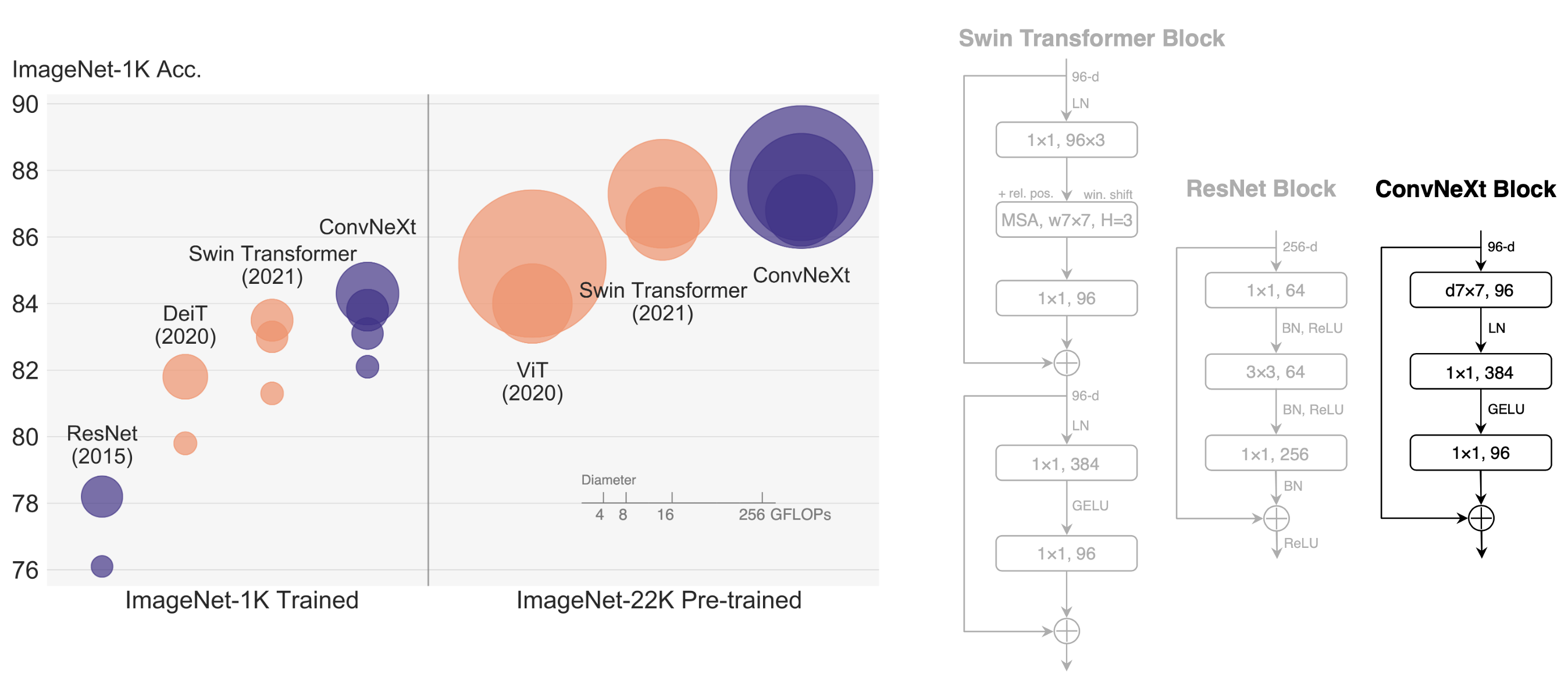
The "Roaring 20s" of visual recognition began with the introduction of Vision Transformers (ViTs), which quickly superseded ConvNets as the state-of-the-art image classification model. A vanilla ViT, on the other hand, faces difficulties when applied to general computer vision tasks such as object detection and semantic segmentation. It is the hierarchical Transformers (e.g., Swin Transformers) that reintroduced several ConvNet priors, making Transformers practically viable as a generic vision backbone and demonstrating remarkable performance on a wide variety of vision tasks. However, the effectiveness of such hybrid approaches is still largely credited to the intrinsic superiority of Transformers, rather than the inherent inductive biases of convolutions. In this work, we reexamine the design spaces and test the limits of what a pure ConvNet can achieve. We gradually "modernize" a standard ResNet toward the design of a vision Transformer, and discover several key components that contribute to the performance difference along the way. The outcome of this exploration is a family of pure ConvNet models dubbed ConvNeXt. Constructed entirely from standard ConvNet modules, ConvNeXts compete favorably with Transformers in terms of accuracy and scalability, achieving 87.8% ImageNet top-1 accuracy and outperforming Swin Transformers on COCO detection and ADE20K segmentation, while maintaining the simplicity and efficiency of standard ConvNets.
@article{liu2022convnet,
  title={A ConvNet for the 2020s},
  author={Liu, Zhuang and Mao, Hanzi and Wu, Chao-Yuan and Feichtenhofer, Christoph and Darrell, Trevor and Xie, Saining},
  journal={arXiv preprint arXiv:2201.03545},
  year={2022}
}
Usage
- This backbone need to install MMClassification first, which has abundant backbones for downstream tasks.
pip install mmcls>=0.20.1
Pre-trained Models
The pre-trained models on ImageNet-1k or ImageNet-21k are used to fine-tune on the downstream tasks.
| Model | Training Data | Params(M) | Flops(G) | Download |
|---|---|---|---|---|
| ConvNeXt-T* | ImageNet-1k | 28.59 | 4.46 | model |
| ConvNeXt-S* | ImageNet-1k | 50.22 | 8.69 | model |
| ConvNeXt-B* | ImageNet-1k | 88.59 | 15.36 | model |
| ConvNeXt-B* | ImageNet-21k | 88.59 | 15.36 | model |
| ConvNeXt-L* | ImageNet-21k | 197.77 | 34.37 | model |
| ConvNeXt-XL* | ImageNet-21k | 350.20 | 60.93 | model |
Models with * are converted from the official repo.
Results and models
ADE20K
| Method | Backbone | Crop Size | Lr schd | Mem (GB) | Inf time (fps) | mIoU | mIoU(ms+flip) | config | download |
|---|---|---|---|---|---|---|---|---|---|
| UperNet | ConvNeXt-T | 512x512 | 160000 | 4.23 | 19.90 | 46.11 | 46.62 | config | model | log |
| UperNet | ConvNeXt-S | 512x512 | 160000 | 5.16 | 15.18 | 48.56 | 49.02 | config | model | log |
| UperNet | ConvNeXt-B | 512x512 | 160000 | 6.33 | 14.41 | 48.71 | 49.54 | config | model | log |
| UperNet | ConvNeXt-B | 640x640 | 160000 | 8.53 | 10.88 | 52.13 | 52.66 | config | model | log |
| UperNet | ConvNeXt-L | 640x640 | 160000 | 12.08 | 7.69 | 53.16 | 53.38 | config | model | log |
| UperNet | ConvNeXt-XL | 640x640 | 160000 | 26.16* | 6.33 | 53.58 | 54.11 | config | model | log |
Note:
Mem (GB)with * is collected whencudnn_benchmark=True, and hardware is V100.